The Metal Order Kit
The MetalReal method for ordering steel once: the whole cut list nested across real bars, bent parts entered as blanks, the order priced as the bars you buy, and a K-factor proved on a drop
MetalReal's free Cut List Calculator counts how many pieces of one length come off one bar, the Metal Cost Estimator prices the pieces, and the Bend Allowance Calculator turns a bent part into a flat blank. Each answers its own question honestly. A real job asks all three at once: several lengths, some of them bent, cut from bars you pay for whole, with a kerf lost at every cut, a squared-off end and a tail the vise has to hold. The kit turns your drawing into one cut list and nests it across the bar you will really cut. On the worked example, a small frame in 40 x 6 mm flat bar needs exactly 18,000 mm of steel: three 6 m bars by length, and a bar short on cut day. The calculator run once per length says five; nested together, longest first, the job takes four. Priced as pieces the steel is $47.49 at an example $1.40/kg; the four bars cost $63.28, and a 719 mm offcut on your rack would replace the fourth. A test bend on a drop back-solves your K-factor (80.4 + 80.4 mm legs on a 150 mm strip is K 0.401) before the batch. Every figure is computed by the site's own calculators, and the worked numbers are examples tagged as such. Seven steps, printable working pages (a cut list, a bar layout, an order and price sheet, a test bend log), reference tables and a quickstart, plus a personalised sheet worked from the numbers you enter in our calculators. It plans material only: the strength of a beam, weld or fastener is a job for a qualified engineer, and it carries the cutting, fire-watch and welding-fume safety lines.
Look inside
Two full pages from the kit, exactly as printed. Click either to read it at full size before you decide.
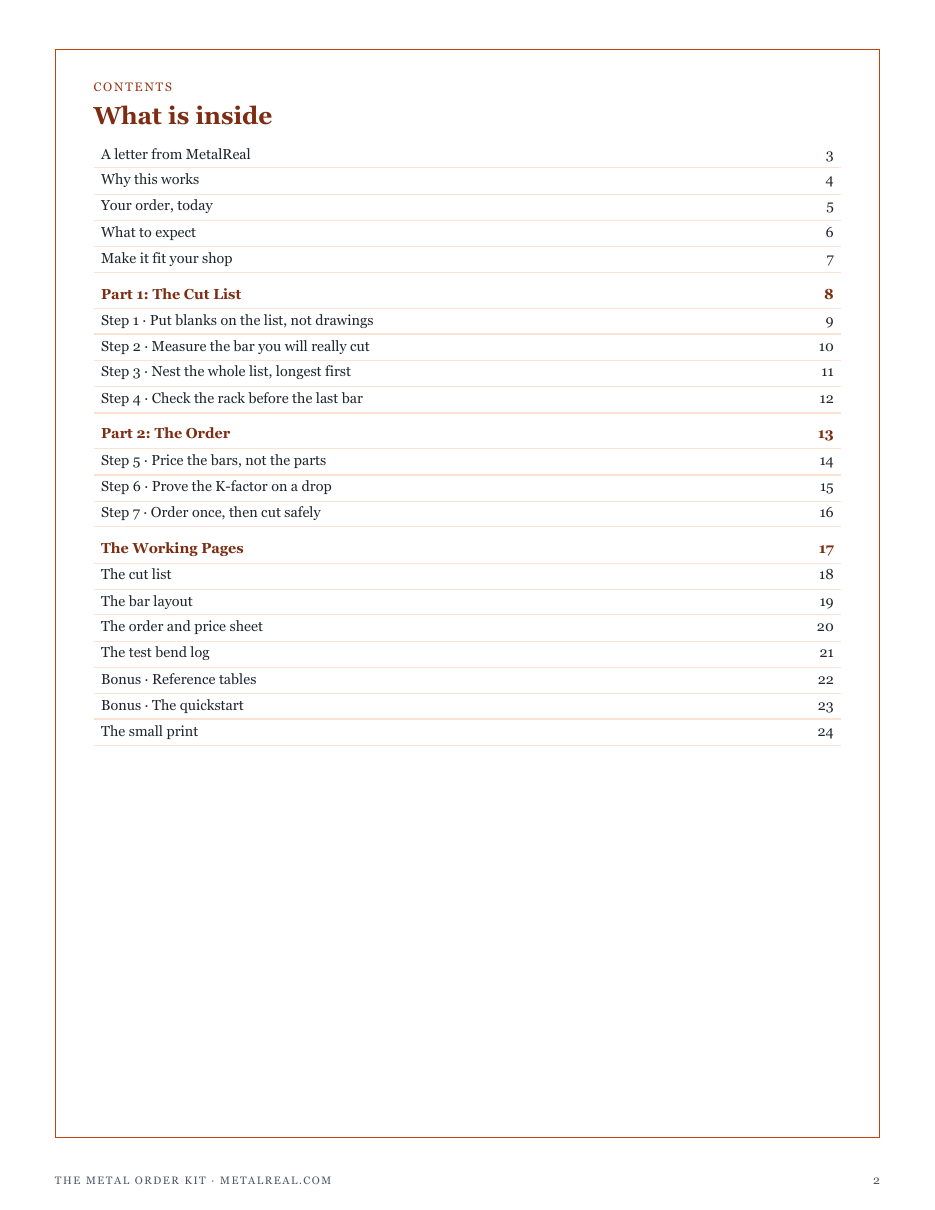
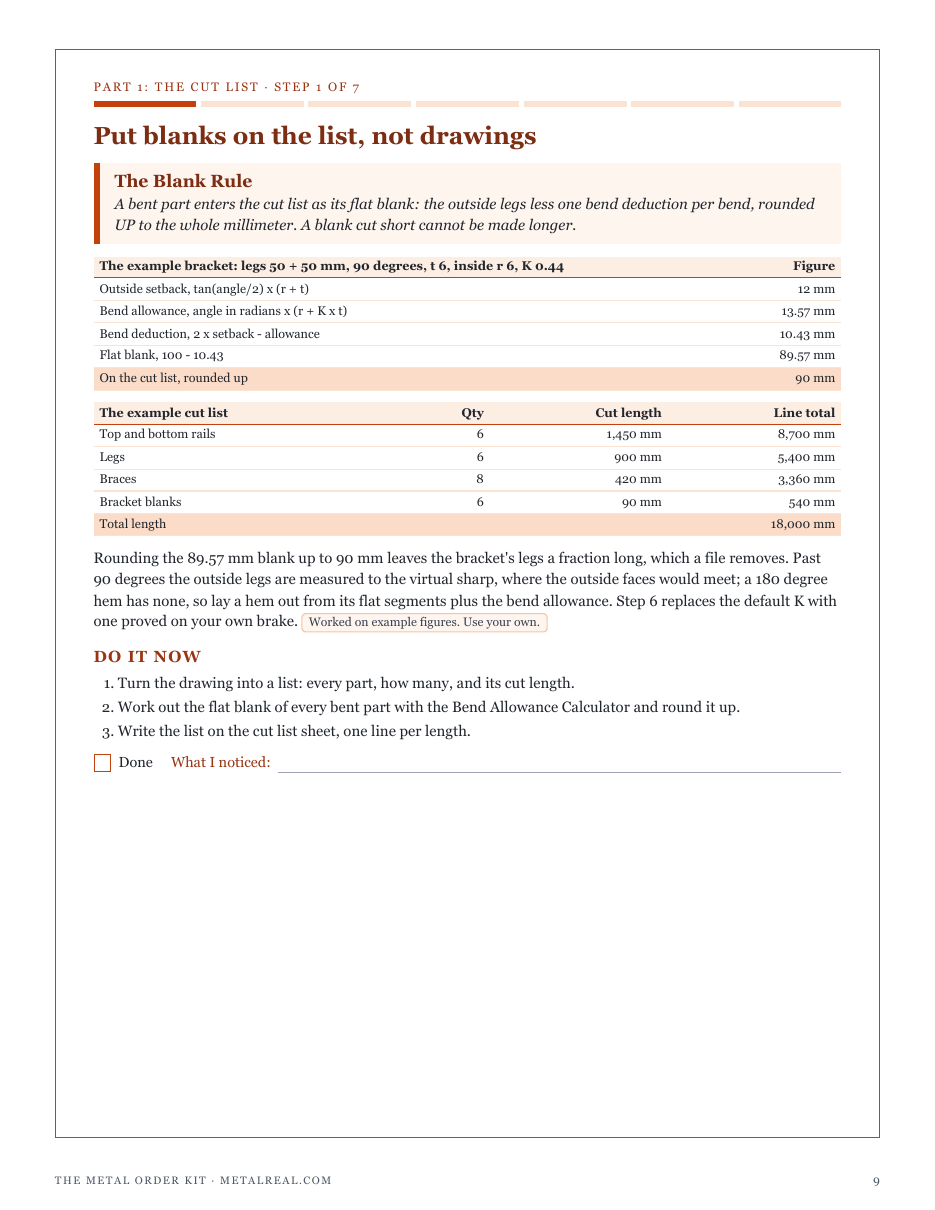
What is in it
- The Blank Rule: every bent part on the cut list as its flat blank from the bend deduction, rounded up
- The Short Bar Rule: the bar after end trim and the vise's clamp tail, every piece costing its length plus one kerf
- The Longest First Rule: the whole cut list nested across bars, against the two shortcuts that undercount and overbuy
- The Last Bar Rule: the rack drop that replaces the last bar, and which offcuts to keep
- The Bar Price Rule: the order priced as the bars you take home, not the pieces
- The Test Bend Rule: your K-factor back-solved from a test bend on an offcut, measured with calipers
- The One Sheet Rule: one order line, one cut sheet per bar, a miscut check, and cutting, fire and fume safety
- Printable working pages: a cut list, a bar layout, an order and price sheet and a test bend log
- Reference tables: pieces per 6 m bar before and after trim and clamp tail, and 90 degree bend deductions, plus a quickstart
- A personalised sheet worked from the numbers you enter in our calculators
- ✓ 24 printable pages
- ✓ 10 sections, worksheets and templates
- ✓ A second PDF worked out from the numbers you enter
- ✓ No account needed, just an email address
- ✓ Instant download; link valid 7 days
Price includes any taxes. Sold by GrabURL, who handle checkout and support. The charge appears on your statement as GrabURL.
The kit picks up where the free Cut List Calculator leaves off. It counts the pieces of one length that come off one bar, but a real job has several lengths, some of them bent, cut from bars you pay for whole. The kit enters bent parts as flat blanks from the Bend Allowance Calculator, takes the end trim and the clamp tail off the bar, nests every length together longest first, checks the rack before the last bar, and prices the bars you take home with the Metal Cost Estimator rather than the pieces. It proves the K-factor on a test bend before the batch. Wear eye and face protection, gloves and hearing protection for cutting and grinding, keep a fire watch where sparks land, deburr every cut, and extract the fume when welding (never weld galvanized steel without removing the coating). The kit plans material only: the strength of a beam, weld or fastener is a job for a qualified engineer. The worked figures are examples, and the K-factor range is a rule of thumb.